
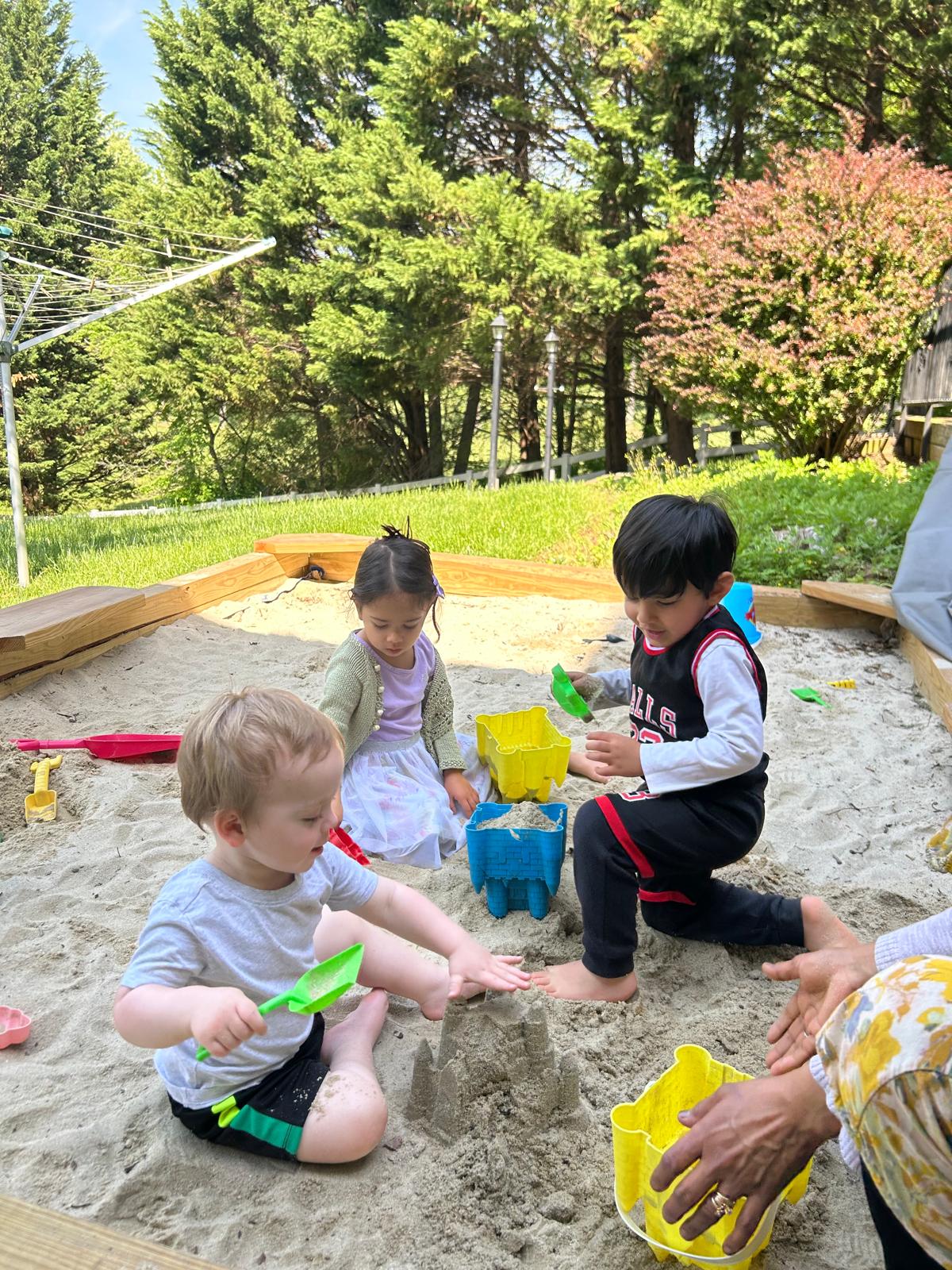
When observing toddlers sitting in a sandbox, sifting fine dry grains through plastic funnels and running scooping shovels through the pit, adults often perceive simple, lighthearted play. However, early childhood development research confirms that dry sand play is far more than a casual pastime. For the under-three age group, manipulating dry sand acts as an early sensory laboratory, a space where fluid movement, gravity, and tactile resistance directly accelerate fine motor control, spatial reasoning, and focus.
For families in Potomac, MD, where expectations for early childhood milestones are exceptionally high, recognizing the educational power behind open-ended play is essential. Below is an analytical look at why dry sand exploration serves as a vital learning tool in a home daycare setting.
The Developmental Mechanics of Dry Sand Play
| Physical Action | Cognitive & Sensory Mechanism | Developmental Outcome |
| Scooping & Pouring Dry Sand | Wrist rotation & visual tracking | Fine motor refinement & hand-eye control |
| Sifting & Funneling | Observing grain velocity & volume | Early physics & cause-and-effect reasoning |
| Shared Sandbox Utensils | Tool negotiation & turn-taking | Social cooperation & emotional self-regulation |
1. Granular Physics: Exploring Flow, Weight, and Volume
Unlike wet sand, dry sand is constantly in motion. It cascades through fingers, flows through strainers, and spills from overfilled cups. This constant movement presents toddlers with their very first practical lessons in fluid dynamics, gravity, and spatial measurement.
In a premier toddler home daycare, dry sandplay creates an immediate, self-correcting feedback loop. Toddlers discover how much weight a small bucket can hold, how fast grains empty from a funnel, and how balance shifts when moving sand from one container to another. These hands-on experiments construct core cognitive frameworks for problem-solving and mathematical concepts long before formal schooling begins.
2. Tactile Calming and Fine Motor Precision
The smooth, free-flowing texture of dry sand offers a uniquely soothing sensory experience. Sifting clean, dry sand through open palms provides deep tactile input that helps organize a toddler’s nervous system, encouraging prolonged states of calm, focused attention.
Simultaneously, using tools like mini-shovels, spoons, and rakes requires precise grip strength and wrist stability. Squeezing shovels and pinching small pebbles found in the sand strengthens the finger muscles needed later for writing, buttoning clothes, and holding utensils independently.
3. Collaborative Play and Early Social Negotiation
Because dry sand can be continuously reshaped without breaking pre-made structures, it encourages open-ended, shared exploration. Toddlers sitting side by side naturally begin to observe each other’s techniques, trade scoops, and fill large bowls together.
In an intimate infant child care or toddler group setting, caregivers leverage dry sand bins to build early social-emotional skills. Children learn to communicate their intentions, practice patience while waiting for a favored sifter, and develop empathy through shared sensory discovery.
The Premium Home Daycare Advantage in Potomac
Toddlers absorb information best when given the freedom to explore natural textures at their own pace. For parents navigating childcare options in Montgomery County, choosing a program that elevates simple daily activities into intentional learning moments makes all the difference.
Right at Home Daycare incorporates structured dry sand play and rich sensory activities into a balanced, research-backed daily rhythm. By offering a cozy, low-ratio environment right here in Potomac, MD, Right at Home Daycare provides the attentive care, safety, and cognitive enrichment your child needs to flourish.
Related posts:
Top 5 Home Daycare Potomac MD Ranking
How to Choose the Best Daycare in Potomac, MD
The First Day of Daycare: How to Prepare Your Child (and Yourself)