
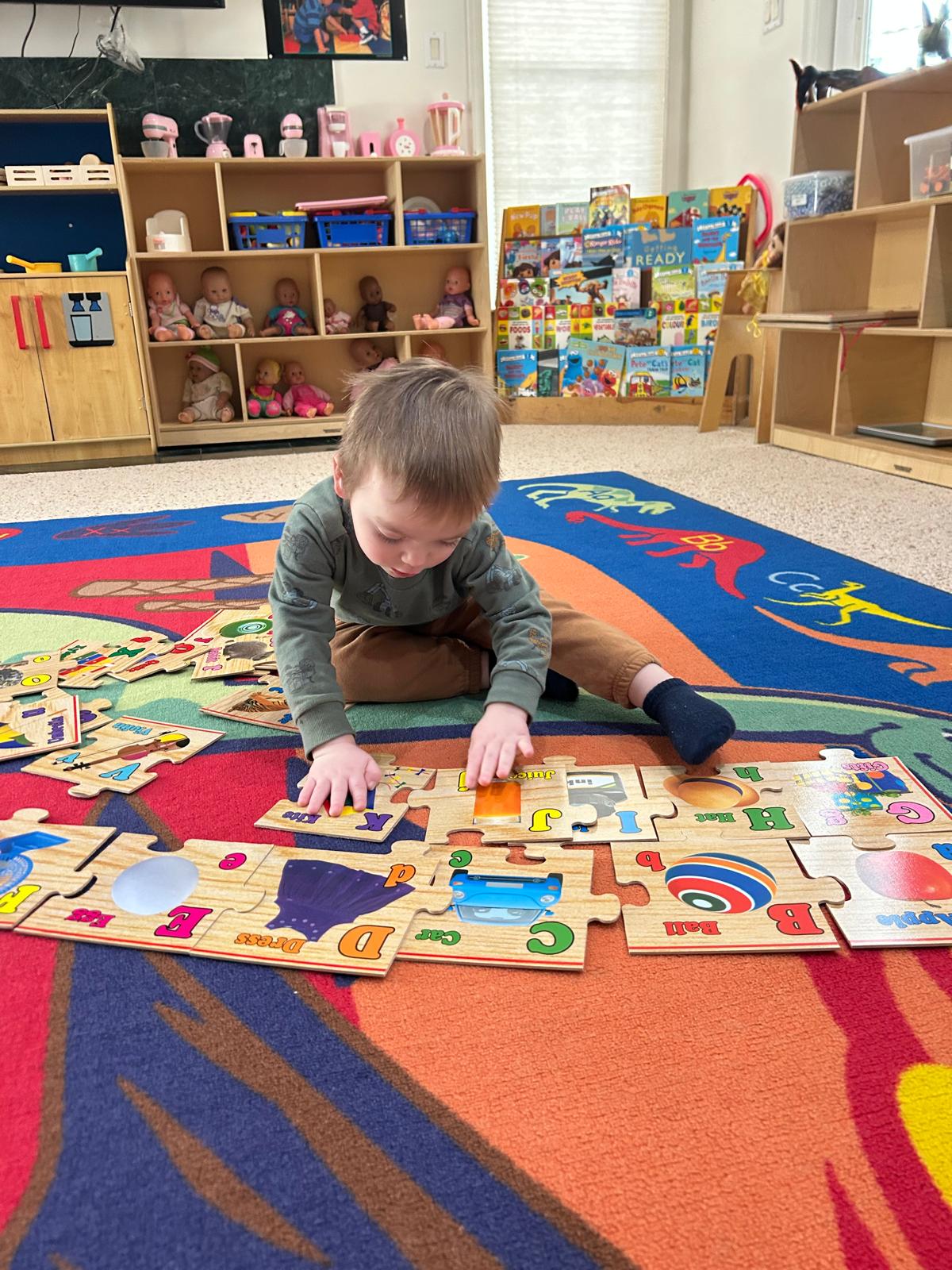
Watching a toddler quietly attempt to fit a wooden peg into a matching slot might look like simple indoor entertainment. However, behind that intense gaze lies a rapid cascade of complex neurological processes. When a young child manipulates a puzzle piece, rotates its orientation, and tests its alignment, they are engaged in high-level spatial reasoning, trial-and-error logic, and motor planning.
For families in Potomac, MD, where early childhood academic foundations are highly valued, understanding the cognitive power of age-appropriate puzzle play is essential. According to early learning research published by the National Association for the Education of Young Children (NAEYC), hands-on manipulative play, like solving puzzles, is a foundational building block for early mathematical thinking, visual discrimination, and executive functioning.
Below is an analytical look at how puzzle play accelerates critical developmental milestones in a low-ratio home daycare environment.
Cognitive & Physical Breakdown of Puzzle Play
1. Spatial Reasoning and Visual Discrimination
To solve a puzzle, a toddler must look at a shape, mentally evaluate its curves and edges, and compare it against an open space on the board. This process trains visual discrimination, the ability to identify subtle differences in patterns, sizes, and orientations.
In a premier toddler home daycare, progressive puzzle play acts as an early introduction to geometry and spatial awareness. The Centers for Disease Control and Prevention (CDC) highlights that recognizing shapes and manipulating objects in space are key cognitive milestones for two- and three-year-olds. By physically rotating puzzle pieces until they fit, toddlers build mental frameworks that make future mathematical and STEM concepts far easier to grasp.
2. Fine Motor Control and Hand-Eye Coordination
Manipulating small wooden knobs or fitting thin cardboard edges together requires precise, deliberate hand movements. A toddler must align their visual perception with their physical hand movement, adjusting their finger pressure and angle in real time.
This tactile feedback loop refines the pincer grasp, the coordination of the index finger and thumb. In an infant child care and toddler setting, strengthening these small hand muscles through daily puzzle play establishes the physical dexterity required later for holding pencils, using scissors, and performing self-care tasks like buttoning shirts.
3. Executive Functioning and Frustration Tolerance
Puzzles possess an inherent educational advantage: they are self-correcting. A piece either fits or it does not; a toddler cannot force a square piece into a circular hole. This binary feedback loop teaches young children how to handle minor frustration and practice problem-solving strategies.
In an intimate, low-ratio group childcare setting, caregivers provide subtle scaffolding, offering encouraging prompts rather than solving the puzzle for the child. This builds executive functioning skills, teaching toddlers to pause, observe, re-evaluate their approach, and experience the immense confidence boost that comes from independently solving a problem.
The Premium Home Daycare Advantage in Potomac
Toddlers develop problem-solving confidence best when provided with a calm, organized space where they can focus without classroom distraction. For parents evaluating childcare standards in Montgomery County, choosing an environment that incorporates structured, age-appropriate cognitive challenges into daily routines is paramount.
Right at Home Daycare incorporates purposeful manipulative play and research-backed learning into every day. By offering an intimate, low-ratio home environment right here in Potomac, MD, Right at Home Daycare ensures your child receives the individual encouragement, safety, and cognitive engagement necessary to build a confident, inquisitive mind.
Related posts:
Top 5 Home Daycare Potomac MD Ranking
How to Choose the Best Daycare in Potomac, MD
The First Day of Daycare: How to Prepare Your Child (and Yourself)